


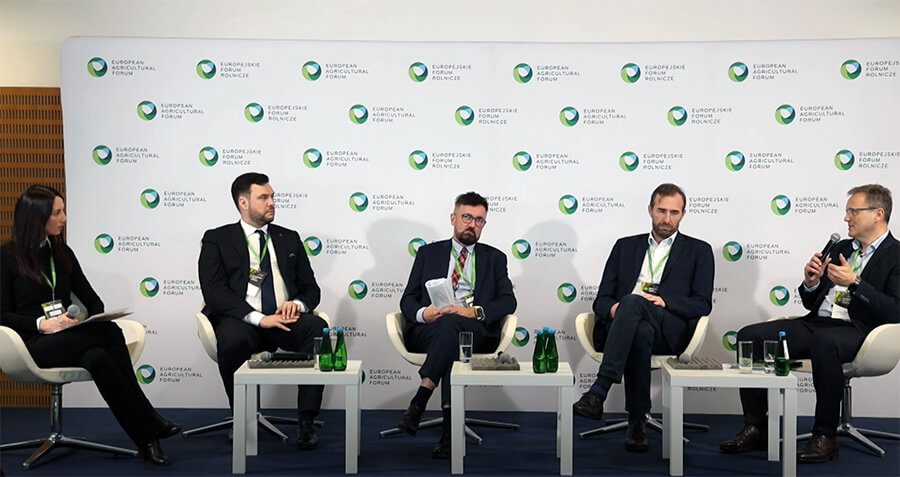
On 19 March 2024, during the European Agricultural Forum, Małgorzata Bojańczyk, Director of the Association for Sustainable Food and Agriculture in Poland, chaired a panel discussion on the role of innovation in agriculture and food production in the context of sustainable agri-food business strategies.
One of the most important topics in the public debate on agriculture today is the profitability of agricultural production. Issues such as geopolitical challenges or climate change are often raised in this context, but it is also worth bearing in mind the issue of the need for competitiveness, which includes not only the farmers themselves, but also other actors in the food chain. Many of the assumptions and requirements regarding competitiveness issues are already set out in relevant European legislation, one of the most important of which is the CSRD on sustainability reporting in three areas: E (Environmental), S (Social) and G (Governance). Under the directive, companies’ first reports must include data for 2024. The obligation to publish CSRD-compliant reports has been phased in, with companies with a turnover of more than €40 million and more than 500 employees having to comply first. In the following years, this obligation will gradually be extended to medium-sized and smaller companies.
The discussion was participated by:
- Adam Nowak – Deputy Minister of Agriculture and Rural Development
- Grzegorz Brodziak – President of the Management Board of Goodvalley Agro S.A., Vice-President of the Management Board of the Polish Agricultural Federation
- Jacek Podlewski – President of the CGFP Management Board
- Tomasz Poninski – Managing Partner of Montis Capital
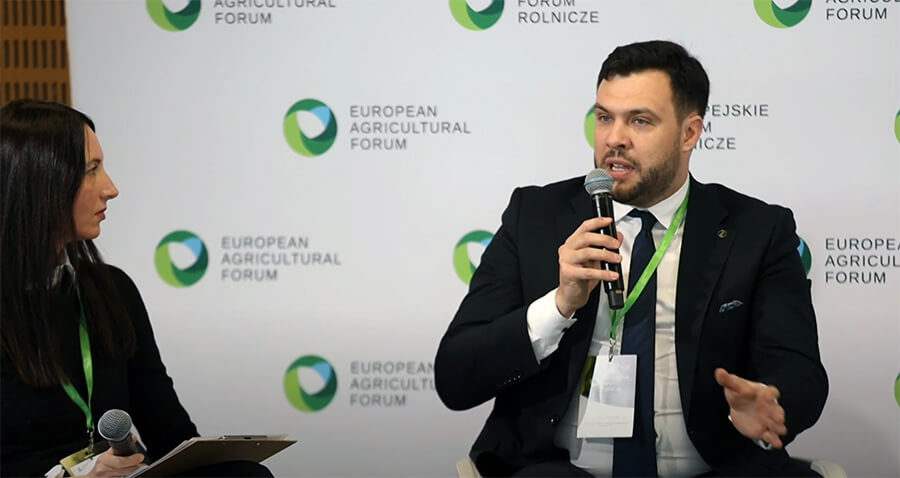
We have to remember that the most important issue from the farmer’s point of view is the profitability of production. The answer to environmental challenges is Agriculture 4.0, which allows for improved and rational use of agricultural inputs, pesticides or fertilisers, and is based on data collection and analysis, which also leads to reduced emissions. The more efficient machinery and equipment offered by Agriculture 4.0 will also make farming safer and friendlier. To implement these tools, we have funds available from the second pillar of the CAP and the National Recovery Plan. Of course, we have to take into account all the players in the food supply market – farmers are the most important part of this chain because they are closest to nature, but we also have to take into account processors, buyers of crops or exporters of food. If we do not look at the food sector as a whole, we will not get the right economic, social and environmental outcomes.
– Adam Nowak pointed out.
Research conducted by the Association for Sustainable Food and Agriculture in Poland in collaboration with Accenture shows that 25% of food companies operating in Poland are sustainability leaders, and half of agri-food companies have already started to implement some ESG solutions, such as sustainable investment strategies. The survey was conducted among more than 200 food companies operating in the Polish market. The study also found that three times as many companies that implemented a sustainability strategy saw an increase in operating profit compared to those that did not.
We are not waiting for ESG reporting, we are simply implementing different solutions in this area because it pays for us. We want to do it, we want to be more competitive – because competitiveness is not just an economic formula, it is also an environmental formula. We want to operate in an environment that is at least not getting worse. We also want to work well with our employees, partners and customers, because we want to generate positive feedback. One of our most important ways of improving efficiency is to manage the soil ecosystem. We believe that water potential, soil health and productivity are largely based on the biological health of the soil. We have already implemented precision agriculture since 2024, including solutions that have enabled us to reduce the use of potash fertiliser by 70%. We have phased out gas cookers and are using heat pumps and solar panels. These are just a few examples of the benefits of innovation.
– said Jacek Podlewski.
From the very beginning, we have built our farm on the premise of sustainability. Our first step 30 years ago, when we took over the State Farm, was to get rid of all coal-fired boilers. Today, more than 70% of our thermal energy comes from our own biogas plant. We finance most of our environmental investments from our own resources. It is important to emphasise the importance of knowledge exchange between large and smaller farms – both in terms of sharing knowledge and working together to implement innovations. It is often the larger farms that have this knowledge and can pass it on, especially when it comes to new technologies.
– emphasised Grzegorz Brodziak.
The sixth edition of the European Agricultural Forum is traditionally held in the Podkarpackie Voivodeship in Jasionka near Rzeszów. The Association for Sustainable Food and Agriculture in Poland was the event’s industry partner.